

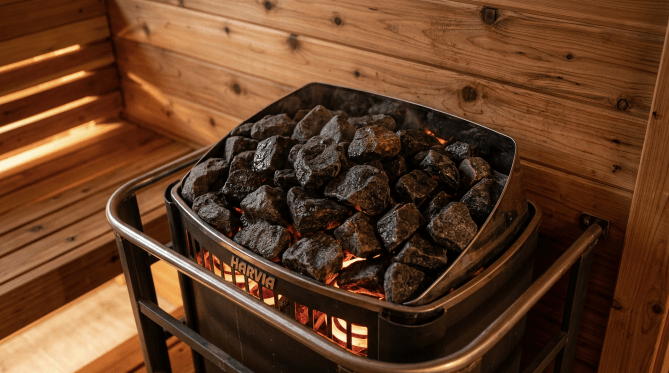
If a full-size 6 to 9 kilowatt sauna heater will not fit your available space, your breaker panel, or your budget, a compact 3 to 3.6 kW electric unit, a corner-mount heater, or a small plug-in heater on a dedicated circuit can still deliver a real sweat in a room as small as 60 to 90 cubic feet. The right choice comes down to three things: how much amperage your panel can spare, your ceiling height, and whether running a new circuit is realistic in your home.
Why Doesn’t a Standard Sauna Heater Fit Every Home?
Most full-size electric sauna heaters draw enough current that they need a dedicated 240V circuit on a 40 to 50 amp double-pole breaker. Older homes with a 100-amp main panel that is already carrying a range, a dryer, and central air often do not have that much headroom left, and adding a subpanel can cost more than the heater itself. On top of the electrical load, a full 6 kW unit is a physically bigger box, and it typically wants a room with at least 7 feet of ceiling height and several feet of stone bed clearance in front. Basements with ductwork, converted closets, and attic nooks frequently fall short on one or both counts before the sauna project even starts.
How Much Heater Power Do You Actually Need?
Sizing a sauna heater starts with cubic footage, not square footage, since heat has to fill the whole box up to the ceiling. A common rule of thumb used by installers is roughly 1 kW of heater output for every 40 to 50 cubic feet of cedar-lined room, with an upward adjustment for glass doors, exterior walls, or unusually tall ceilings, all of which bleed heat faster than solid insulated cedar. A small 4 by 4 foot room at 6.5 feet tall works out to around 104 cubic feet, which a 3 to 3.6 kW heater can handle on a standard 20 or 30 amp 240V circuit rather than the 40 to 50 amp service a bigger unit needs. Undersizing leaves the room stuck in the 130s instead of climbing into the 150 to 190 degree range that makes a session feel like a real sauna rather than a warm closet.
What Do Compact and Corner-Mount Heaters Trade Away?
Smaller heaters are not simply scaled-down versions of full-size units. They carry less rock, often 20 to 40 pounds of basalt or peridotite river stone compared to 80 pounds or more in a large freestanding heater, so the steam burst from a ladle of water is shorter and the stones cool faster if you pour too generously. Corner-mount designs solve the footprint problem by tucking the heater into an unused triangle of floor space, freeing up bench room, but they usually need a guard rail installed at the manufacturer’s specified height to keep bare skin and loose towels away from the element. Digital controls with an external sensor are worth the extra cost on a compact unit, since the tighter stone bed makes overheating easier if the thermostat is mounted too close to the rocks.
Where a Compact Heater Fits in the Budget
Pricing for a compact 3 to 3.6 kW electric heater typically lands between $350 and $700 before installation, with corner units and digital-control models sitting toward the top of that range. Retailers that specialize in home sauna equipment, including Sweat Decks, list heaters by kilowatt rating and matching cubic footage side by side, which makes it easier to land on a unit sized to your actual room instead of guessing and ending up with a heater that either trips the breaker or never gets the room hot enough. Add stones, a guard rail if one is not included, and a bucket and ladle, and total heater-side spending for a small build usually stays under $900.
Are Wood-Burning or Infrared Options Worth Considering?
A wood-burning sauna stove solves the electrical panel problem entirely, but it introduces a chimney run through the roof or an exterior wall, which rules it out for most interior conversions and adds real installation cost. Infrared panels sidestep both issues since they plug into a standard 120V outlet and run at a lower 120 to 140 degree operating temperature with no stones or steam involved, but that is a genuinely different experience from a traditional heat-and-steam sauna, not a substitute for one. For someone specifically set on the löyly of water hitting hot stone, a right-sized compact or corner electric heater is usually the more direct fix when a full-size unit does not fit, rather than switching categories entirely.
See also: The Complete Guide to Term Loans and Business Loans in 2026
Planning the Electrical Work
Even a small 3 to 3.6 kW heater needs a dedicated 240V circuit, which means budgeting $400 to $1,200 for an electrician depending on how far the run is from your panel and whether a permit and inspection are required in your area. Skipping the permit on a DIY install can create real problems at resale, since a home inspector who spots an unpermitted 240V circuit will flag it. It is worth getting a quote before you commit to a heater size, since in some homes the electrical work costs more than the heater itself, and that number can change which unit makes sense.
Frequently Asked Questions
Can a sauna heater run on a regular 120V outlet?
Only small plug-in heaters rated at roughly 1.5 kW or less are built for a standard 120V, 15-amp household outlet. Anything above that needs a dedicated 240V circuit sized to the heater’s amperage draw, which usually means bringing in an electrician.
How small can a sauna room be and still work?
A well-insulated cedar-lined space as small as 60 to 90 cubic feet, roughly a 4 by 4 foot footprint at 6 feet tall, can reach a solid sweat with a properly matched 3 to 3.6 kW heater. Below that, heat loss through the door and any glass usually outpaces what a small unit can replace.
Do compact sauna heaters heat as well as full-size units?
For a correctly sized small room, yes. A compact heater matched to cubic footage reaches the same 150 to 190 degree range as a larger unit. What it usually sacrifices is stone capacity, so the steam from a ladle of water is shorter and less forgiving of overpouring.
Is a corner-mount heater safe near wood benches?
Yes, when installed with the manufacturer’s minimum clearance to combustibles and a guard rail that keeps skin and towels away from the stones. Corner units are designed for tight rooms, but the clearance numbers in the install manual are not optional.
References
- Cardiovascular and Other Health Benefits of Sauna Bathing: A Review of the Evidence, Mayo Clinic Proceedings, 2018
- Clinical Effects of Regular Dry Sauna Bathing: A Systematic Review, Evidence-Based Complementary and Alternative Medicine, 2018
- Benefits and risks of sauna bathing, The American Journal of Medicine, 2001
- Effects of heat and cold on health, with special reference to Finnish sauna bathing, American Journal of Physiology, 2018
By Daniel Foss